Foolish Ridge: Deacon’s Shocking Praise For an “Honest” Woman
Deacon’s Revelation: “I Forgot What Honesty Looks Like”
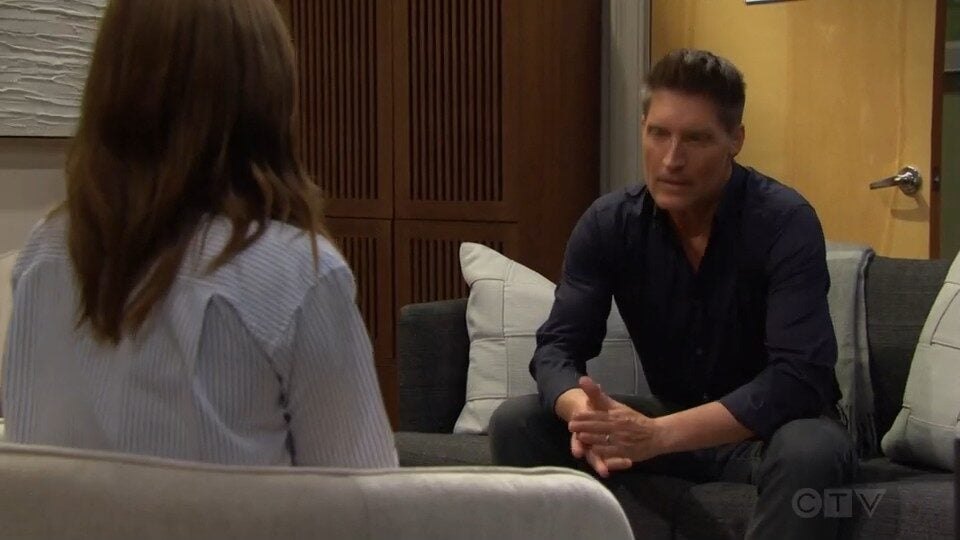
The aroma of freshly brewed coffee and moral judgment hung heavy in the air of Deacon Sharpe’s tiny, cluttered apartment above the Il Giardino restaurant. Deacon, still wearing his chef whites from the morning shift, was pacing. He wasn’t worried about the day’s specials; he was wrestling with a truth that had blindsided him.
He was talking to Hope Logan, his daughter, about Dr. Taylor Hayes.
“I’m telling you, Hope, it hits you like a brick wall,” Deacon muttered, running a hand over his jaw. “You spend so long navigating the chaos—the lies, the manipulation, the constant drama—that you forget what the clean air feels like. And then you look at her, and it’s like seeing honesty for the first time.”
Hope, who had heard her father wax poetic about several women over the years—including the notoriously chaotic Sheila Carter—sipped her latte with a look of skeptical concern. “Dad, Taylor is my stepmother, my friend, and a genuinely good person. We all know that. But she’s also a world-class psychiatrist. She knows how to make people feel seen.”
Deacon stopped pacing and fixed his daughter with an intense gaze that shut down her clinical assessment instantly.
“No, this is different,” he insisted. “I was talking to her yesterday, right? About the parole board nonsense, about my past, about the kind of guy I used to be. And she wasn’t judging me. She wasn’t analyzing me. She was just listening.”
He sighed, the sound heavy with the weight of his own tumultuous history. “It wasn’t just that she listened, Hope. It’s what I saw in her eyes when she looked back. No artifice. No game. Just… pure and honest. I honestly forgot what that was like.”
Deacon leaned back against the counter, a genuine, raw feeling of bitterness surfacing. “And then I thought about Ridge.”
Hope knew where this was going. Ridge Forrester, the perpetual object of desire and the man Deacon perpetually measured himself against.
“Ridge is a fool, Hope. A stone-cold, Grade A, oblivious fool for ever letting her go.”

The Foolishness of the Golden Boy
Deacon’s bitterness wasn’t just envy; it was existential confusion. He, the ex-con, the perpetual outsider, saw the true value of Taylor Hayes—a value that the golden-boy, Ridge Forrester, constantly overlooked in his cyclical pursuit of Brooke.
“Ridge had a woman who was smart, talented, and—I’m saying this as someone who knows a liar when he sees one—actually good,” Deacon argued, his voice low with conviction. “She’s a respected professional. She rebuilt her life after decades of his nonsense. She offered him peace, stability, and unconditional love. And he threw it away every six months for the drama.”
Hope shifted uncomfortably. She had spent her entire life navigating the gravity of the “Bridge vs. Taylor” pull, and her father was vocalizing the harsh reality everyone else whispered.
“It’s about the chaos, Hope,” Deacon stated, tapping the counter sharply. “That’s why Ridge keeps going back to Brooke. It’s not love; it’s addiction. He’s addicted to the high-stakes, competitive, on-again-off-again cycle. Taylor offered him a soft landing, and Ridge is too messed up to accept anything that isn’t a perpetual crisis.”
Deacon confessed a deeper, more personal truth: “I spent my life chasing the chaos, too. I chased the dangerous women, the risky schemes, the fast money. It’s all I knew. And when I looked at Taylor, it was like looking at the life I shouldhave aimed for—the quiet integrity I never had the courage to build.”
He paused, a flicker of genuine admiration in his eyes. “And Ridge had it. He had the opportunity to choose the quiet light, the true partner, and he gave it up for the same old firework show. That’s why he’s a fool. He chose the drama he deserved over the peace he desperately needed.”
The Ripple Effect: Brooke’s Silence
The ultimate irony of Deacon’s revelation lay in the fact that Brooke Logan—the supposed winner of the Ridge sweepstakes—was the one who suffered most from his analysis. Deacon’s praise of Taylor was a direct condemnation of Brooke’s entire relationship structure.
Brooke often accused Taylor of being obsessed with Ridge, but now, the dynamic was exposed: Ridge was obsessed with the competitive cycle, and Brooke was complicit in maintaining the chaos because it kept her in the running.
The question of Taylor’s “honesty and purity” wasn’t merely a romantic assessment; it was a profound acknowledgment of Taylor’s professional and personal integrity, which had remained intact despite her years in the toxic Forrester ecosystem. Taylor possessed a clear moral compass, something Deacon—and Ridge—had often found elusive.
Deacon continued to reflect on the nature of their relationship: “Taylor doesn’t try to change you. She accepts the broken pieces and tells you to try harder. That’s the difference. Brooke always wanted to fix me, save me, turn me into the man Ridge already was. Taylor just wants me to be the best version of Deacon I can be.”
This distinction—between a partner who seeks to fix you and one who seeks to witness you—was the core reason Deacon was left blushing. Taylor had offered him validation, not a project.
The Path Forward: Choosing the Light
Deacon’s encounter with Taylor didn’t just illuminate Ridge’s folly; it changed Deacon’s path. He realized his pursuit of stability required more than just attending parole hearings; it required him to seek out genuine connections and discard the toxicity he’d mistaken for excitement.
“I need to be better for you, Hope,” Deacon concluded, pouring himself a fresh cup of black coffee. “I need to be the man Taylor believes I can be. Not for her, not for Ridge’s shame, but for my own daughter.”
The resolution of the perennial triangle was often framed around which woman Ridge would finally choose. But Deacon’s raw, emotional testimony flipped the script: perhaps the true victory belonged to the woman who understood her own worth enough to walk away from the chaos, leaving the foolish golden boy to deal with the inevitable implosion of his own making.
Deacon, the ex-con, now had a clear moral map, gifted to him by the “honest and pure” eyes of the woman his rival was too blind to keep.